FABRX M3DIMAKER
M3DIMAKERTM
The Future of Compounding Starts Here
Automated. Precise. Scalable. Pharmacy First 3D Printing.
Unlock the next generation of pharmaceutical compounding with the M3DIMAKER™, the world’s first clinically validated 3D printer designed for real-world pharmacy operations.
Pete Pharma brings over a decade of innovation from hospitals, universities, and clinical research—and transforms it into a commercially scalable solution for U.S. compounding pharmacies.
Experience the printer in action.
See any dosage form printed in minutes.
Why Pharmacies
Are Switching to 3D Printing
Massive Efficiency Gains
- Print up to 300 dosage forms in 10 minutes
- Minimal technician touch time
- Remove blister packing, sealing time, and cold packing shipping logistics
- Dispense directly into standard Rx bottles
Automate Manual, Labor-Heavy Workflows
Traditional compounding requires weighing, mixing, encapsulating, polishing, and logging.
3D printing reduces this to:
Load → Print → Harden → Dispense
Lower Input Costs vs. Conventional Compounding
Our anhydrous excipients cost less than traditional capsule bases—AND provide better stability.
Proven, Validated Technology
- Built on 10+ years of FABRx clinical research
- USP dissolution completed on all formulas
- 6-month BUD using anhydrous proprietary bases
How It Works
Massive Efficiency Gains
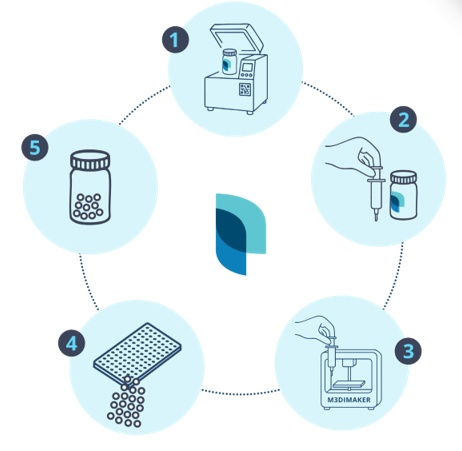
Prepare the Anhydrous Base
- Fill Syringe (or use Prefilled cGMP Syringe Inks)
- Load Syringe → Software Optimizes Extrusion
- Print Into Mold → Hardens → Up to 300 Tablets at a Time
- Dispense into Standard Prescription Bottles
What the
M3DIMAKER™ Can Print
Dosage Forms Supported
- Immediate Release (IR) tablets
- Extended Release (ER) tablets
- Rapid dissolve / ODT tablets
- Water dissolvable Nasal Irrigation Tablets
- Chewables
- Veterinary treats
- Gel tablets
- Troches
- Suppositories
- Oral film strips
Key Technology
Benefits
- Automated Oral Dosage Form Production
- No capsule machines. No blister packs. No sealing equipment.
- 70–90% Reduction in Labor Time
- Examples:
- Progesterone capsules → 35 min
- Printed oral tablets → 10 min
- (245-day workload comparison yields >$25,000 in labor savings)
- Higher Profit Margins
- Lower material costs
- Faster production
- Less waste
- Partnership business model: We only win when you win
- (No software fees, user fees, or maintenance fees)
- Examples:
- (Coming Soon) Prefilled cGMP Printer API Inks
- Skip formulation steps—print instantly.
- Consistent viscosity. No mixing errors. No batch failures.
ROI Snapshot for Pharmacies
Metric | Capsule Method | 3D Printing | Difference |
Annual Labor | $30,625 | $5,100 | $25,525 |
Material Cost | $19,600 | $15,925 | $3,675 |
Annual Profit | $96,775 | $125,975 | +$29,200 profit |
*Based on 2,450 scripts/year at a $60 average selling price.
Key Technology Benefits
Our model is built to align incentives:
You produce. You profit. We earn only when you earn.
Included With Every Partnership
Dissolution & potency testing completed on each formula
Onsite installation + workflow integration
Unlimited software users
No recurring software or maintenance fees
Provider facing educational marketing materials
Patient facing educational marketing materials
Ready to Transform
Your Compounding Workflow?
M3DIMAKER™ Video Library
Explore the Technology in Action
1. Full Automation: Blister Filling, Tracking & Autoloading
The M3DIMAKER Ecosystem Overview
Watch the complete automated workflow—blister filling, real-time tracking, and autoloading systems designed for high-throughput operations.
2. Capsule Filling & Suppository Production
Capsule Filling SSE (Semi-Solid Extrusion) & Pellet Printing
See how the M3DIMAKER produces uniform pellets and semi-solid filled capsules with precision and repeatability.
3. Semi-Solid Extrusion (SSE) Technology
M3DIMAKER™ 2 Platform Demonstration
This video showcases SSE capabilities for creams, gels, semisolids, and pastes—ideal for dermatology and veterinary formulations.
4. FABRx Educational Webinar
Latest Advances in Pharmaceutical 3D Printing
Learn from the world leaders in pharmaceutical 3D printing as they discuss clinical use cases, regulatory considerations, and future applications.